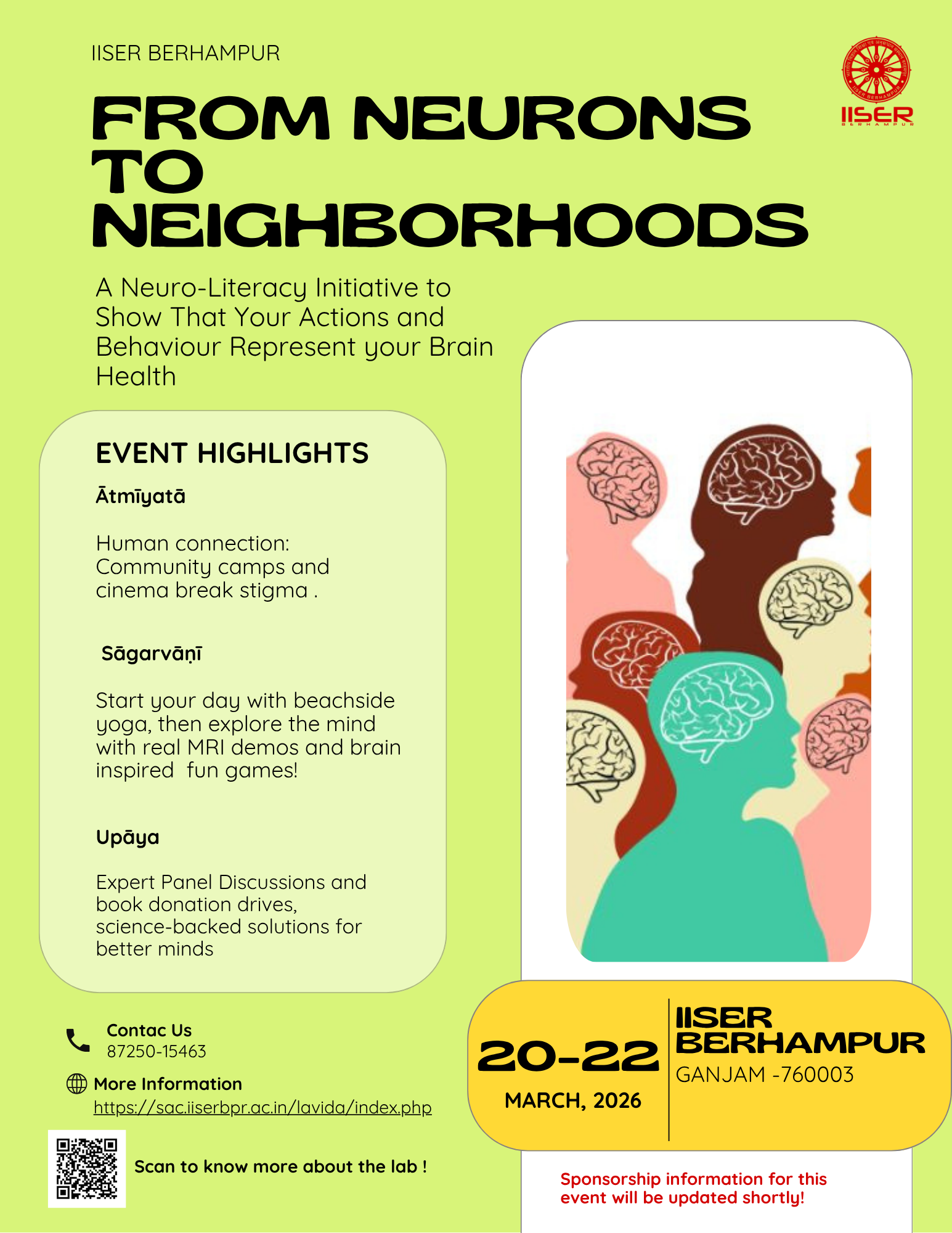
From Neurons to Neighborhoods: A Neuro-Literacy Initiative to Show That Your Actions and Behaviour Represent your Brain Health
Time & Location
March 20-22, 2026
Ganjam, Odisha
About the event
Brain Awareness Week aims to foster public enthusiasm and support for brain science through education and awareness. Our three-day program aims to reframe the stigma around common mental health challenges.
The project employs a Three-Day Multi-Modal Intervention (March 20–22, 2026) to combat mental health stigma in Southern Odisha’s communities. The goal is to present these conditions not as untreatable curses, but as objective, treatable brain-based network dysfunctions.
Key events include expert-Guided Sunrise beach yoga session, a movie screening an Immersive MRI-Lab Walkthrough for students, expert panel discussion with neurologists and psychiatrists to devise an actionable plan for Odisha. Let's move From Neurons to Neighborhoods and talk about brain health!
Schedule
-
୨୦ ମାର୍ଚ୍ଚ, ୨୦୨୬ | March 20, 2026
Phase I: Ātmīyatā (Transformation Through Trust) | Cinematic Views and Community Activation for Brain Health
Show More
Phase I directly combats supernatural stigma and addresses literacy and access gaps in the community. The intervention counters reliance on non-scientific healing by framing conditions like anxiety and depression as objective, brain-based network dysfunctions. This is achieved by conducting awareness camps in villages and rural health centres, and hosting a movie screening to connect with the audience and spread awareness about malpractices. To ensure localised empowerment and access, the project will distribute Resource Packets—which include mental health rating scales, user manuals, and clinical referral pathways—to trusted conduits like ASHA workers and Panchayat Leaders. These large-scale events are coordinated using IISER Berhampur's student clubs, including the Yavanika Theatre Club and the Village Development and Activities Club (VDAC).
*ASHA (Accredited Social Health Activist) workers are frontline community health facilitators, pivotal to India's rural healthcare system, serving as the first point of contact and trusted liaisons between communities and health services.
-
୨୧ ମାର୍ଚ୍ଚ, 2026 | March 21, 2026
Phase II: Sāgarvāṇī (Dialogue with the Sea) | The Dialogue: Connecting Synapses, Yoga, and Scientific Literacy
Show More
Phase II focuses on Continued Practice & Accessibility by promoting community integration and building scientific trust. The day begins with an Expert-Guided Sunrise Yoga Session by the sea, led by Shri Kashi Nath Yadav (Physical Education Instructor, IISER Berhampur), followed by a lecture from Dr. Vivek Tiwari (IISER Berhampur) and Dr. Swati Mishra (MKCG Hospital, Berhampur) explaining yoga's importance for synapse formation and mood regulation pathways. To address Scientific Literacy, especially among high school students (ages 15–25), the project will translate core science concepts like neuroplasticity and brain connectivity using accessible, non-textual aids. This involves an Immersive MRI-Lab Walkthrough at the IISER Berhampur campus, simplifying "Brain networks" and their relation to mental health via hands-on brain models and simple Odia/Telugu analogies. The team will collaborate to procure DIY neuroscience kits and leverage the Institute's research ecosystem, including its state-of-the-art 3T MRI and the Flagro Art club, to ensure maximum utility and clear communication.
-
୨୨ ମାର୍ଚ୍ଚ, ୨୦୨୬ | March 22, 2026
Phase III: Upāya (Solutions from Science) | Solutions from Science: Expert Action Plans and Resource Libraries
Show More
Phase III is designed to overcome clinical and structural gaps by focusing on Community Buy-in and addressing the Lack of Objective Biomarker. To identify key research and clinical lacunae and shape a regional strategy, a High-Calibre Expert Panel will be hosted at IISER Berhampur. This panel, featuring regional experts like Consultant Paediatric Neurologist Dr. Debasis Panigrahi, Neurologist Dr. Umanath Padhy, Psychiatrist Dr. Swati Mishra, and Neurobiologist Dr. Vivek Tiwari, will devise an actionable, context-specific plan for Odisha. The discussion will be live-streamed across various social media platforms to reach a wider audience. To ensure cultural sensitivity and long-term adoption, the project will establish dedicated mental health and psychiatric resource libraries (small bookshelves) in rural health referral centers and primary schools. These efforts leverage IISER's outreach modalities for accessible, Quadri-lingual (English/Hindi/Odia/Telugu) demonstrations.